

The operating system for automotive after-sales and parts
Every car, every part, every figure. One system that can prove it.
RomanoECS runs workshops and parts businesses end to end: reception, job cards, stores, buying, insurance claims, the floor and the books. Then it answers the owner in money, and its figures open to the documents that made them.
Live a couple of months after signing. Built for automotive from day one.
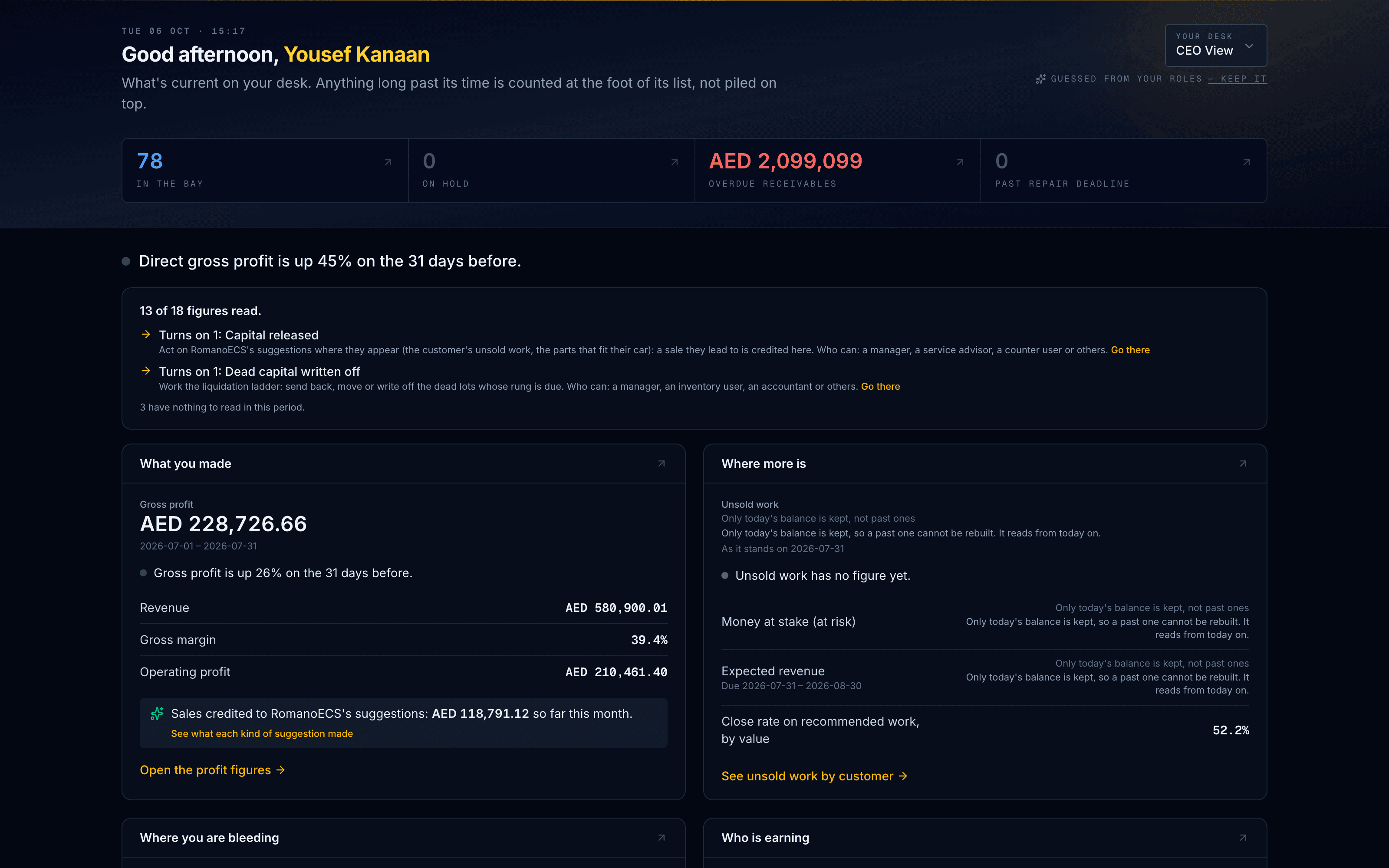
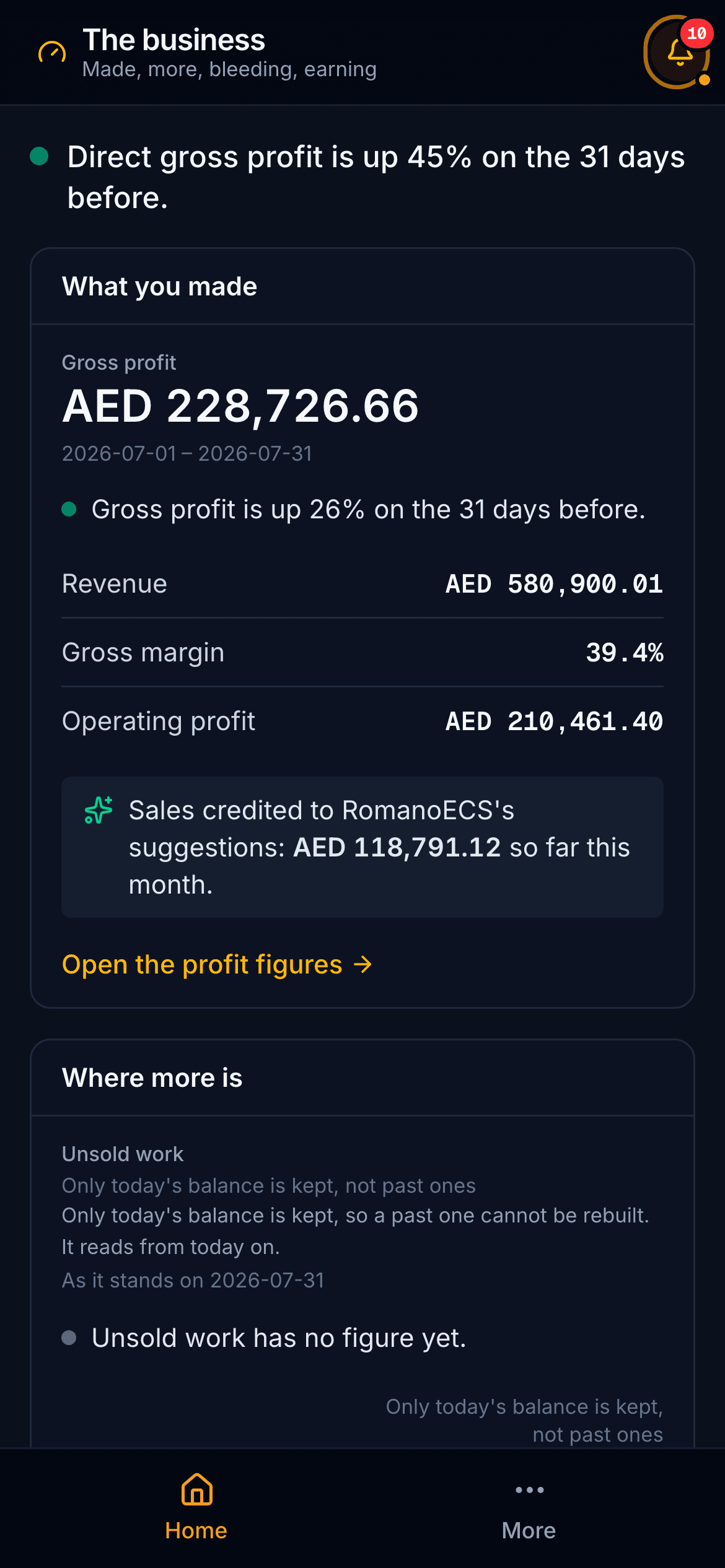









- working screens
- 400+
- screens built for the phone
- 40+
- business modules
- 40+
- integration test suites, run against a real database
- 800+
- Arabic and English, every screen and every document
- EN + AR
The way it runs today
Most workshops run on ten systems that don't know each other.
In the store
A part leaves and nobody knows which car it went to.
On the floor
Work is done that never reaches the invoice.
In the office
The books close late, by estimate, and the branch's profit is a surprise.
The answer isn't another program per problem. It's one system where a fact is written once and travels to the ledger.
Answers in money
Four questions. Answered in money.
- What you made
- Where more is
- Where you are bleeding
- Who is earning
Its figures open to their documents. The invoices, job cards and journal entries behind each one, ready to download.
A figure it can't vouch for says why. “Too little history yet”, “not booked here for this period”, then what would turn it on, and who can when it takes a person. Never a quiet zero.
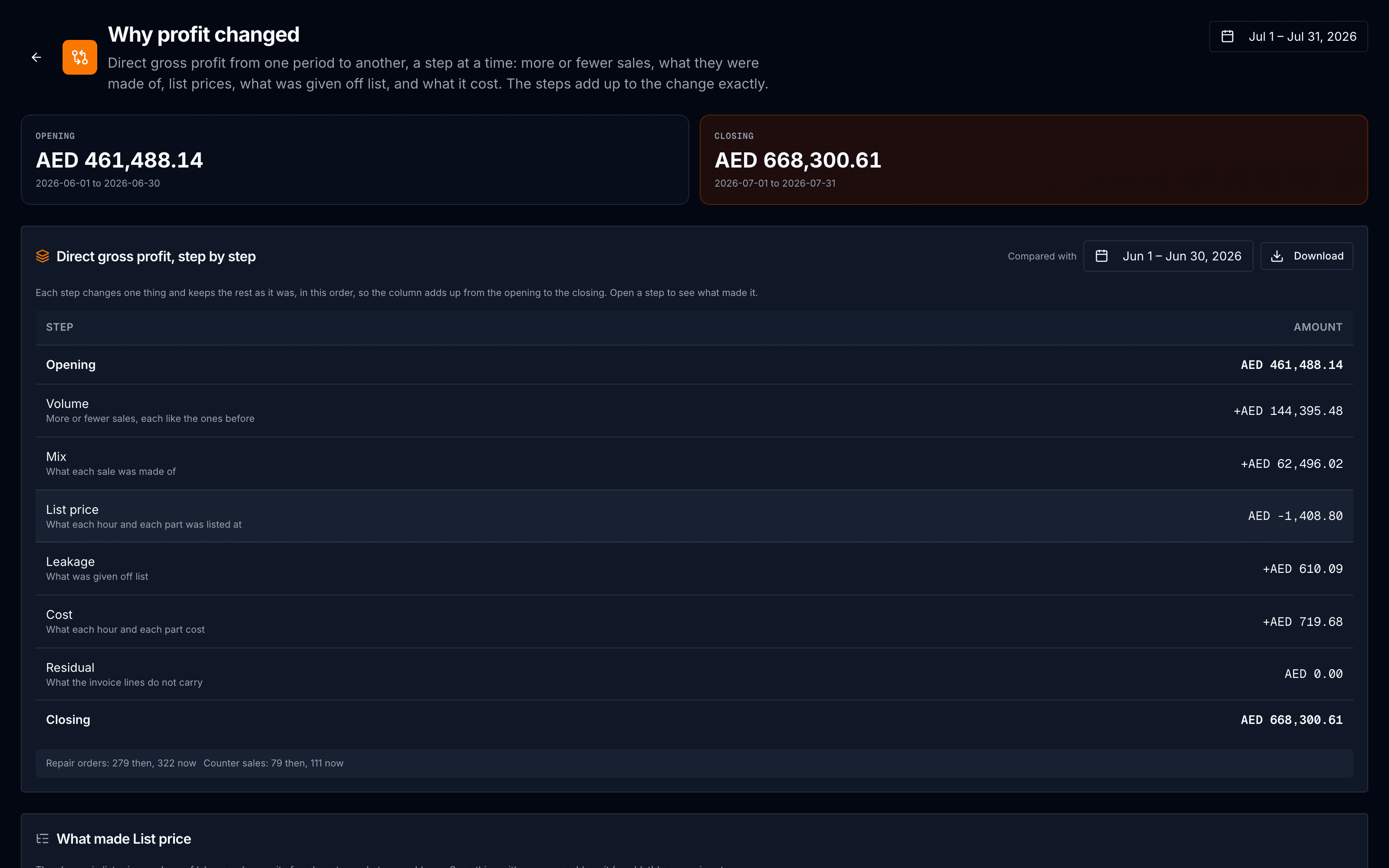





Why gross profit changed. A step table from last period's gross profit to this one's: volume, mix, list price, leakage, cost, and what is left over. The steps add up to the change exactly, and each opens onto its documents.
How profit is made
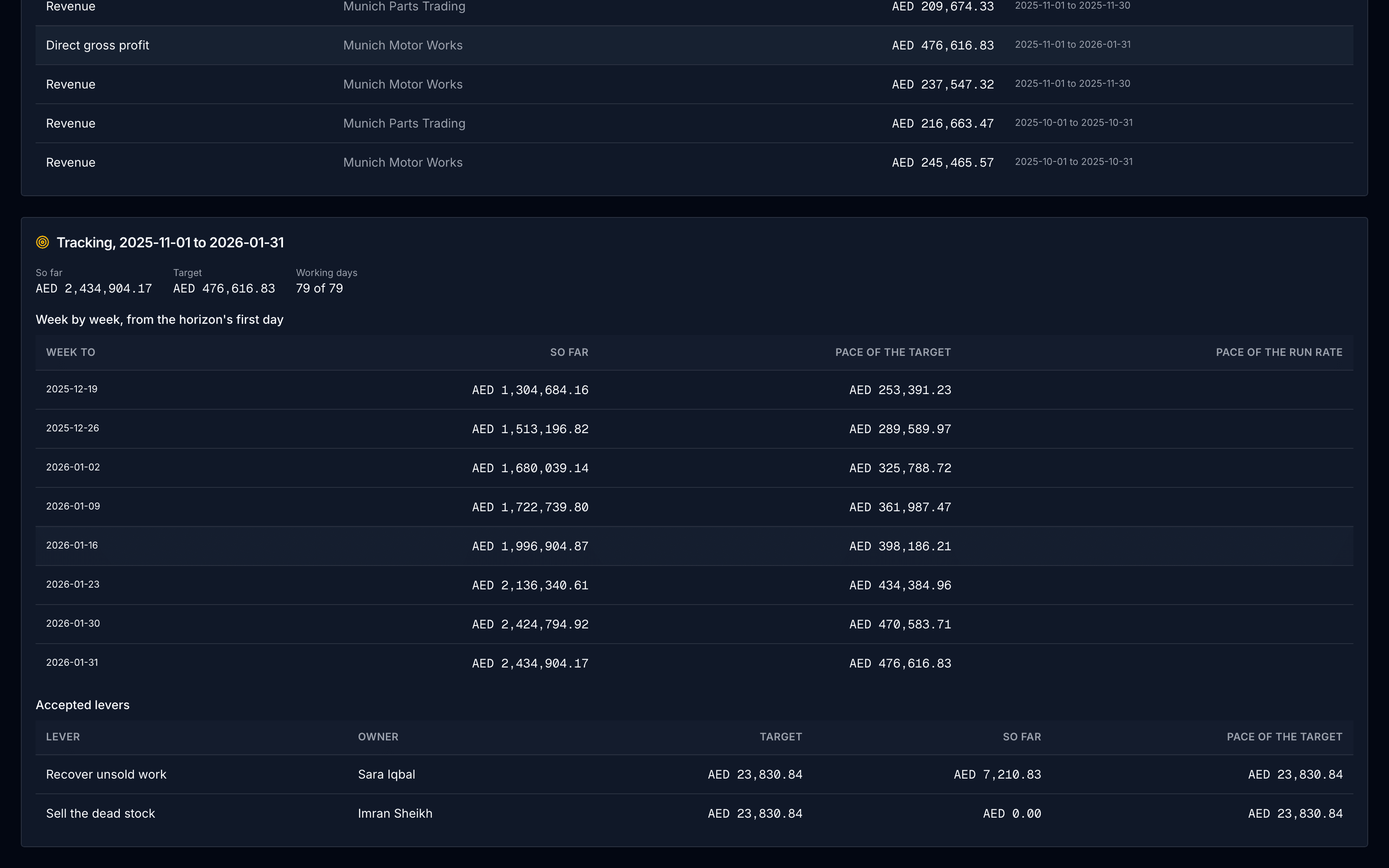
Name a goal. Get the plan.
The driver tree shows how profit is made, with each driver's run rate. Ask for a goal, this much in this many months, and get the plan: each driver's gap, the levers, sized where the data measures what they move, an owner you name on each, and the pace tracked week by week.
The branch league
Every branch, side by side, on the same figures.
Revenue, margin, absorption, unsold work, what was given away: branch beside branch. Branches are ranked. People never are.
The figures an OEM measures
The figures an OEM measures.
Each with its formula shown under it.
- Fixed absorption
- fixed operations gross profit ÷ overhead
- Effective labour rate
- labour revenue ÷ labour hours billed
- Average repair order
- revenue on repair orders ÷ repair orders
- Hours per repair order
- billed labour hours ÷ repair orders
The weekly brief
The four answers, first thing every week.
What moved most, what broke from the usual, and each goal against its pace. In the app and by email, with a PDF. Every number in it comes from the data, or it isn't sent.
Money can't slip out
The discount past authority, the unbilled job, the part priced under cost. Caught and named.
Leak: Selling under cost
What stops it: A part can't be priced below its true cost plus your minimum margin. Only someone with override rights lets it through.
Leak: Discounts nobody sees
What stops it: Every line is stamped with its pricing policy when it is issued. “Given away” walks from list price to what the invoices kept, by who raised each document and who approved it.
Leak: Nobody asked before it left
What stops it: Before an invoice issues, a discount past authority, a part under its floor, a sublet under cost or labour under book time asks for a reason, and a second person if you want one.
Leak: Work done, never invoiced
What stops it: Finished work that never reached an invoice is a figure of its own, opening to the job cards behind it.
Leak: The same supplier bill, twice
What stops it: The same supplier's number, entered twice, is caught before its lines are typed. An exact repeat passes only with a written reason.
Leak: Paying for goods that never came
What stops it: A supplier invoice for ordered stock isn't approved, or paid, before its goods reach the store. Price and quantity gaps against the order show before you pay.
Leak: Stock lost, broken or stolen
What stops it: Written off only under a named reason, by a named person, with a second approval above your threshold if you set one. The profit screens show it as a loss of its own.
Leak: Money asleep on the shelves
What stops it: Dead stock in money, per branch, with a plan to clear it.
The line that refuses. A part priced under its true cost plus your minimum margin stops at the quotation. Only someone with override rights can approve the price.
Given away
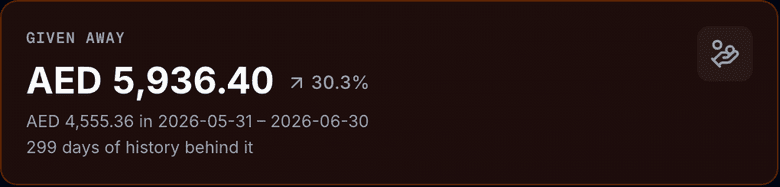








Given away, step by step. From work at list to what the invoices kept: discounts by policy and past it, overrides, unbilled work, labour sold under book, credits. Then by person: who raised each one, and who approved it.
Every night, the system audits its own books.
Some two dozen checks: money that moved with no entry, customer and supplier balances against their control accounts, stock against the ledger. What it finds waits in the app for you and your accountant. A night with nothing to report sends nothing.
Groups and governance
From one branch to a group of companies. Every desk its own, every approval on a name.
One system, every level
- GroupGroup statements, with the internal margin removed
- CompanyIts own books and its own document series
- BranchIts own figures, side by side in the branch league
- WarehouseIts own stock, always inside its branch's company
From one branch to a group of companies. Trading between your own companies creates both sides at once.
Everyone lands on their own desk
- Service Desk
- Parts Counter
- Insurance Desk
- Purchasing
- Stores
- Workshop Floor
- Finance
- CEO View
Eight desks, each opening on its own work.
Every door
Confidential documents.
Label a deal for a named audience and it disappears for everyone outside it, from lists, counts, search and notifications. Whoever keeps the books still sees it, so the ledger stays whole. Every label change is logged with a reason.
Every approval carries a name and a time.
Approvals, overrides, confidentiality labels and corrections are recorded, and a correction never erases: the original stays beside it. The job card keeps its whole history.
Discussion on the document itself.
Mentions, links, attachments and seen-by on job cards, invoices, parts, suppliers, orders and claims, instead of in a chat group.
Keyboard-first for power users. ⌘K reaches every command and finds customers, cars, parts, job cards and invoices. The frequent actions have their own key, and any command can be given one.
The whole system
The same system runs the floor, the counter and the books.
RomanoECS is an ERP built for automotive after-sales and the parts trade in the Gulf: car-repair workshops, dealers' service operations and parts resellers, from one branch to a group of companies. One system runs job cards and the workshop floor on phones, the stores, insurance claims, the parts counter and buying, the customer's own app and every conversation, and double-entry books that the documents write themselves, with e-invoicing for Saudi Arabia, the UAE and Oman. It answers the owner in money, and its figures open to the documents behind them. It works in Arabic and English, every customer runs on its own instance and database, and we implement it directly, with no partner chain.
Operations
Workshop management from the shelf to the customer's phone.
Nobody edits a quantity by hand.
Parts
The auto parts ERP, from the counter to the export lane.
Built for the parts counter and the buying desk, not bolted onto a workshop.
On the page
Finance
Books the documents write, a close that is signed.
The breadth a big ERP lists in its reporting module, already built, without a report-writing project.
Ready, not a project
A big-ERP rollout, typically
Live a year or two after signing
- Discovery
- Blueprinting
- Consulting
- Customisation for the automotive business
- Testing
- Go-live
RomanoECS
Live a couple of months after signing
- Data migrated
- Desks set up
- People trained
- Live
Compare
Holding an ERP proposal? Score us line by line.
Everything a big ERP proposal lists, plus the workshop it leaves to an add-on. Download the capability matrix and put it in your scoring sheet.
Download the capability matrixAgainst the three kinds of system on your shortlist
By kind, never by brand. Where a mainstream system of that kind does the same as standard, its cell is lit beside ours.
| What you are scoring | The big global suiteRolled out by consultants | The dealer systemBuilt around the manufacturer | The modular ERPAssembled from apps and partners | RomanoECSBuilt for the automotive business |
|---|---|---|---|---|
| Signing to go-live | Typically a year or more of consulting and modification | Months | Months, plus custom development | A couple of months |
| Workshop processes out of the box | A consultant project | Matches: Yes, shaped by the manufacturer | Assembled from modules | Yes, built with the people who run them |
| Figures that open to the documents behind them | Report drill, varies | Varies | Report drill, varies | Yes, and the documents download |
| A figure it can't compute says why, instead of showing zero | No | No | No | Yes, and what would turn it on |
| Phone-native floor, stores and owner | Separate mobile apps | Limited | A generic mobile app | 40+ phone screens; store work carries on offline |
| Floor hardware (QR, kiosks, wall boards) shipped with it | Third party | Varies | Varies | Shipped and installed |
| Fitment, with the evidence for each fit | No | From the maker's catalogue | No | Learned from your own jobs, with its evidence |
| Insurance claims kept as a ledger of approvals | No | Varies | No | Yes, line by line |
| WhatsApp with customers and suppliers, threaded onto the record | Add-on | Varies | Varies | Built in, from each advisor's own number or the company line |
| The books audit themselves every night | Varies | Varies | No | Yes, and what it finds waits in the app |
| GCC e-invoicing, VAT returns and payroll | Add-on | Varies | Varies | Built in |
| Arabic and English, documents included | Varies | Varies | Matches: Yes | Yes, every screen and every document |
Signing to go-live
- The big global suite
- Typically a year or more of consulting and modification
- The dealer system
- Months
- The modular ERP
- Months, plus custom development
- RomanoECS
- A couple of months
Workshop processes out of the box
- The big global suite
- A consultant project
- The dealer system
- Matches: Yes, shaped by the manufacturer
- The modular ERP
- Assembled from modules
- RomanoECS
- Yes, built with the people who run them
Figures that open to the documents behind them
- The big global suite
- Report drill, varies
- The dealer system
- Varies
- The modular ERP
- Report drill, varies
- RomanoECS
- Yes, and the documents download
A figure it can't compute says why, instead of showing zero
- The big global suite
- No
- The dealer system
- No
- The modular ERP
- No
- RomanoECS
- Yes, and what would turn it on
Phone-native floor, stores and owner
- The big global suite
- Separate mobile apps
- The dealer system
- Limited
- The modular ERP
- A generic mobile app
- RomanoECS
- 40+ phone screens; store work carries on offline
Floor hardware (QR, kiosks, wall boards) shipped with it
- The big global suite
- Third party
- The dealer system
- Varies
- The modular ERP
- Varies
- RomanoECS
- Shipped and installed
Fitment, with the evidence for each fit
- The big global suite
- No
- The dealer system
- From the maker's catalogue
- The modular ERP
- No
- RomanoECS
- Learned from your own jobs, with its evidence
Insurance claims kept as a ledger of approvals
- The big global suite
- No
- The dealer system
- Varies
- The modular ERP
- No
- RomanoECS
- Yes, line by line
WhatsApp with customers and suppliers, threaded onto the record
- The big global suite
- Add-on
- The dealer system
- Varies
- The modular ERP
- Varies
- RomanoECS
- Built in, from each advisor's own number or the company line
The books audit themselves every night
- The big global suite
- Varies
- The dealer system
- Varies
- The modular ERP
- No
- RomanoECS
- Yes, and what it finds waits in the app
GCC e-invoicing, VAT returns and payroll
- The big global suite
- Add-on
- The dealer system
- Varies
- The modular ERP
- Varies
- RomanoECS
- Built in
Arabic and English, documents included
- The big global suite
- Varies
- The dealer system
- Varies
- The modular ERP
- Matches: Yes
- RomanoECS
- Yes, every screen and every document
The module map
The questions a board asks
How long until we're live?
A couple of months from signing. The software is ready; there's no automotive customisation to build. We move your customers, vehicles by chassis number, stock with its lots and cost, and your opening balances, set up every desk, and train your people on site.
Who implements it?
We do, directly. There's no partner chain between you and the product.
What happens when we need something changed?
Your request comes straight to us, and ships as part of the product, for everyone.
Whose data is it, and where does it live?
Yours. Every customer runs on its own instance with its own database, never shared with another company, in a standard open database (PostgreSQL) you can take with you. Where your country's law keeps the data at home, it is hosted in your country.
Is it secure?
Your data is in a database of its own, never shared. Each person lands on the desk their role opens. Confidential documents disappear for everyone outside their audience, from lists, counts, search and notifications. Every approval, override and correction carries a name and a time, and a correction never erases the original.
Can it connect to our other systems?
We bring your existing data over as part of going live. After that, bank statements import from a file, a supplier's parts list pastes straight in as stock items, and a labour catalogue pastes in to be sorted into operations. A link to another system you run is scoped with you and built by us.
What's our risk in choosing you over a big vendor?
RomanoECS is built on standard, open technology, with 800+ integration test suites, 12,000+ tests in all, run against the full system on a real database. Your data stays in an open database you control.
Does it work in Arabic?
Every screen and every customer document, in Arabic and English.
Built in a workshop
Built inside a working workshop. Every day, not in a lab.
- integration test suites, run against the full system on a real database
- 800+
- individual tests across those suites
- 12,000+
Shaped by the people who use it
Every module was shaped with the people who use it. Their feedback became the screens.
See it run
See it run your workshop.
A private walkthrough on your own kind of operation: your branches, your stores, your numbers' shape. Forty-five minutes.
Live a couple of months after you sign.